Don't be indecisive - people don't take your decisions seriously.
Is being indecisive and fickle the same thing...?
Monday, 7 May 2007

Friday, 4 May 2007
Family relationships are awe-inspiring.
Family relationships are awe-inspiring. It's amazing how a mother feels instant love, affection and protection for her child as soon as it's born, even before it is born. To everyone else it's a shrivelled up slimy shreiking creature with no personality, nothing to give or offer. It's amazing how a man and woman who have had completely separate upbringings, separate lives, separate set of ideals and dreams and aspirations - fundamentally strangers - can come together and experience feelings and emotions never felt before until he cannot imagine life without her in it and vice versa, until they think how was it possible this man/woman was not in their life all these years.
The mother/child and husband/wife relationship is more profound to me than others. It's natural; God made a mother so - if you wanna be scientific about it, I suppose maternal proptection is necessary for the continuation of the species. And God put mercy and affection between a husband and wife. Despite it being the "norm" it doesn't fail to make one wonder. I remember when I was studying philosophy of religion in college we discussed what a miracle means. Many philosophers defined anything that happens out of the ordinary (ie defying natural law) thus indicating God's intervention as a miracle. Of course I didn't agree with that as God doesn't "defy" natural law; natural law is His law and He does as He wills, not bound by anything. His actions can be witnessed in everything in the universe, including natural law, hence the most "normal" things can be viewed as miracles, like a baby being born. Or the love between a husband and wife.
I was flicking through some womens' magazines a few weeks ago and noticed the stories that most struck me were "imbalances" in these natural yet miraculous aspects of human relationships. For example parents dumping and disowning non-adult children, cheating on spouses etc. Things like that don't make sense to me, I conclude that these people are seriously disturbed and abnormal. They don't have what Allah puts in humans - and even animals - naturally. Closer to my own observations and experience, it saddens and even depresses me when I see children treating their parents like crap, thus completely disregarding the huuuge burden on us as children to do birr towards them. I hold my hands up and admit I'm far from an exemplary daughter and I don't excuse that when I say there's a difference between failing due to weakness and failing due to absolute disregard. Likewise when I see parents mess up their kids' marriage and thus their life for their own selfish reasons - aren't parents the one people who should love and sacrifice unconditionally? Similarly when I see husbands having very little or no mercy and love for the woman who has sacrificed and undergone hardship for him... It doesn't make sense to me. Love, care, consideration, compassion towards at least our children, spouses, parents is it not?
The mother/child and husband/wife relationship is more profound to me than others. It's natural; God made a mother so - if you wanna be scientific about it, I suppose maternal proptection is necessary for the continuation of the species. And God put mercy and affection between a husband and wife. Despite it being the "norm" it doesn't fail to make one wonder. I remember when I was studying philosophy of religion in college we discussed what a miracle means. Many philosophers defined anything that happens out of the ordinary (ie defying natural law) thus indicating God's intervention as a miracle. Of course I didn't agree with that as God doesn't "defy" natural law; natural law is His law and He does as He wills, not bound by anything. His actions can be witnessed in everything in the universe, including natural law, hence the most "normal" things can be viewed as miracles, like a baby being born. Or the love between a husband and wife.
I was flicking through some womens' magazines a few weeks ago and noticed the stories that most struck me were "imbalances" in these natural yet miraculous aspects of human relationships. For example parents dumping and disowning non-adult children, cheating on spouses etc. Things like that don't make sense to me, I conclude that these people are seriously disturbed and abnormal. They don't have what Allah puts in humans - and even animals - naturally. Closer to my own observations and experience, it saddens and even depresses me when I see children treating their parents like crap, thus completely disregarding the huuuge burden on us as children to do birr towards them. I hold my hands up and admit I'm far from an exemplary daughter and I don't excuse that when I say there's a difference between failing due to weakness and failing due to absolute disregard. Likewise when I see parents mess up their kids' marriage and thus their life for their own selfish reasons - aren't parents the one people who should love and sacrifice unconditionally? Similarly when I see husbands having very little or no mercy and love for the woman who has sacrificed and undergone hardship for him... It doesn't make sense to me. Love, care, consideration, compassion towards at least our children, spouses, parents is it not?
Tuesday, 1 May 2007
2.5%.
Given to the poor by the rich.
That's all you need to know about zakah right? Anything more than that and it's too complex -and it's a pillar of Islam, it's not meant to be complicated right? WRONG! One thing this course made me feel was guilt. Yes it's one of the five pillars of Islam and percisely because a fifth of the deen is based on it is why there is so much to it. After all how vast is the study of tawheed? And fiqh of salah - need I say more?
In fact the first two statements are two of the biggest misconceptions about zakah that were refuted in the course i.e. not only 2.5% and not only given to the poor, and even if a portion is given to the poor it's not always the definition of "poor" that we commonly perceive. Alhamdulillah I'm so glad I did this course but I came out with deep concern that a vast majority of Muslims just don't know about zakah. And that's extremely worrying for so many reasons.
It was a good weekend alhamdulillah, albeit tiring. What is an AlKauthar course without tiredness and lack of sleep though. It felt good being at an AlKauthar course AND actually doing it after just babysitting for Umm Maymo at the last two. It was very interesting being at an AlKauthar course with my good friend whom I pretty much picked on her all the way through. But come on, she practically danced up and down when she saw the planes taking off and landing on the runway opposite the river just outside the uni lecture theatre, she mumbled and laughed in her sleep (she says she was awake but yeah right), and she put up her hand when she didn't understand something and said, "I'm lost!" (her Manc accent sounded very sharp against all the Londoners) and giggled! Oh my goodness. The brothers were chuckling and the Sheikh was grinning.
Anyway please check out the POW (Pearls of Wisdom) on the AlKauthar forums and don't worry - POWs tend to be non-technical so you don't have to worry about your head hurting. It was a challenging course but it would be boring if it was too easy. And it was anything but boring. I hope everyone who reads this and hasn't done the course definitely makes it a priority to do it if it is repeated in the future. It definitely makes sense why the sheikh said it is fard 'ain knowledge, thus the regulations of travelling with a mahram not being so stringent.
Insha'Allah I'm going to put some notes up in the future. Watch out for them.
Given to the poor by the rich.
That's all you need to know about zakah right? Anything more than that and it's too complex -and it's a pillar of Islam, it's not meant to be complicated right? WRONG! One thing this course made me feel was guilt. Yes it's one of the five pillars of Islam and percisely because a fifth of the deen is based on it is why there is so much to it. After all how vast is the study of tawheed? And fiqh of salah - need I say more?
In fact the first two statements are two of the biggest misconceptions about zakah that were refuted in the course i.e. not only 2.5% and not only given to the poor, and even if a portion is given to the poor it's not always the definition of "poor" that we commonly perceive. Alhamdulillah I'm so glad I did this course but I came out with deep concern that a vast majority of Muslims just don't know about zakah. And that's extremely worrying for so many reasons.
It was a good weekend alhamdulillah, albeit tiring. What is an AlKauthar course without tiredness and lack of sleep though. It felt good being at an AlKauthar course AND actually doing it after just babysitting for Umm Maymo at the last two. It was very interesting being at an AlKauthar course with my good friend whom I pretty much picked on her all the way through. But come on, she practically danced up and down when she saw the planes taking off and landing on the runway opposite the river just outside the uni lecture theatre, she mumbled and laughed in her sleep (she says she was awake but yeah right), and she put up her hand when she didn't understand something and said, "I'm lost!" (her Manc accent sounded very sharp against all the Londoners) and giggled! Oh my goodness. The brothers were chuckling and the Sheikh was grinning.
Anyway please check out the POW (Pearls of Wisdom) on the AlKauthar forums and don't worry - POWs tend to be non-technical so you don't have to worry about your head hurting. It was a challenging course but it would be boring if it was too easy. And it was anything but boring. I hope everyone who reads this and hasn't done the course definitely makes it a priority to do it if it is repeated in the future. It definitely makes sense why the sheikh said it is fard 'ain knowledge, thus the regulations of travelling with a mahram not being so stringent.
Insha'Allah I'm going to put some notes up in the future. Watch out for them.
Wednesday, 25 April 2007
Adab al Mufrad Series 1 recap
I do so love the adab al mufrad classes. That Friday feeling that Abu Eesa was talking about made everyone smile and nod knowingly; it's true, there's a real feeling of peace, tranquility and iman at that specific time in that specific place.
Anyway my excuse for posting the notes so late: laziness, stuff happening at home, procrastination, going to Birmingham for Mark of a Jurist and laziness. I've decided not to post all of the notes I made last year here yet and just to post what I'm making as we're going along insha'Allah. I hope you guys benefit and I hope any mistakes I make don't weigh heavily on my scale of bad deeds and that Allah helps us all to implement the 'ilm He entrusts us with.

RECAP OF SERIES ONE
DATE: 13/04/07
Weak hadiths can be used in adab if they meet the following conditions:
1. Can’t be very weak e.g. munkar narrator – known liar.
2. Has to come under something already mentioned (generally) elsewhere e.g. being good to parents.
3. Mention it is weak when relating it because otherwise attributing to the Prophet (sal Allahu 'alaiyhi wa sallam) something he may not have said i.e. lying upon him.
Birr – not translatable in one word. Includes good; dutiful; easy – no anger, resentment, bitterness, uptightness, laidback; righteousness, merciful, obedient.
Adab to others connected to adab to parents. Good adab to others voluntary, to parents obligatory.
Birr to parents only in permissible things.
Birr to mother more emphasised – she’s more emotional, prone to get angry quicker, take bad feelings to extremes e.g. cursing, therefore imperative to please her and ensure her calmness. Displeasing father has more immediate implications – he can beat you, become socially disgraced if he disowns you, withdraws you from inheritance. With mother, easier to get false sense of security if she is displeased.
Mother has greater right of good treatment – to spend time with her, be easy on her etc. Father has greater right to obedience and your finances.
Birr not contingent on their being good to you, birr is their right whether you like it or not. Likened to taxes. :-)
Soft speech, nothing said to harm them.
Don’t think about repaying them, never possible. An obligation, have to do it hence just get on with it.
Dependence on parents from cradle to grave – physically in womb and early years, later on for advice, finance etc up to death. Even after their death we hope for inheritance. At no stage are they dependent on us so no point thinking we can repay them.
Different hadiths give emphasis in different ways how serious ‘uqooq (opposite of birr) to parents is.
Barakah of ones’ life increases with birr, not just number of years, including adding to ones’ good deeds, blotting out bad deeds, increasing ones’ honour and respect.
If ones’ parents are still alive don’t miss out on the chance to enter Paradise.
If you want anyone to make du’a for you, make it your parents.
DATE: 20/04/07
CONTINUE OF RECAP

Even fard can be put aside over service to parents e.g. jihad and hijrah (as long as they are fard kifayah).
Birr includes not just being good to them but also being wary of their emotions which influences their du’aas. Just from result of their du’aas one can end up in the fire. Knowledge of this science should be invested in and passed on just because of this – can decide whether we go to Paradise or Hell.
Treatment of parents unaffected by status or even existence of their deen (i.e. non-Muslim) or their being good to you: birr not mukafaha (from kifayah) i.e. "you be good to me, I’ll be good to you, you suffice me, I’ll suffice you."
Certain aspects of adab don’t always make logical sense e.g. not sitting before your father (one can argue my father doesn’t mind my sitting before him, I don’t see what birr has got to do with sitting before or after someone etc etc) hence needs to be studies not assumed – naql before aql.
Some athar have sahaba saying something is fard/haram – these are treated as hadith as they wouldn’t say so without it originating from the Prophet (sal Allahu 'alaiyhi wa sallam).
Not calling parents by first name – here cause needs to be looked at. Prohibition because it is offensive but if offence is caused if parent prefers first name then although unusual, it is to be respected.
Hadith/athar: Kulayb ibn Manfa’a said: "My grandfather said, ‘Messenger of Allah, towards whom should I be dutiful?’ He said, ‘Towards your mother, your father, your sister and your brother. Then towards your relative, the nearest to them. This is an obligatory duty and those ties of kinship must be maintained.’"
"Kinship" not accurate translation of rahim. Relation from blood, marriage or adoption.
Adab covers our interaction with everything/everyone around us – animals, environment, people. From these, adab to kin comes first, from that adab to parents comes first.
Good adab to parents is a cure for ills of society.
The way Imam Bukhari arranges and names his chapters of hadith is a field of fiqh in itself!
Rahim also means womb – place of mercy at its’ extreme where foetus completely helpless and dependent. Womb completely sustains and maintains its life.
Rahma defined as "to not punish the one who deserves punishment and to do good to the one who doesn’t deserve it".
Understanding rahma helps to understand greatness of relations of the womb and other kin.
Difference of opinion on what rahim includes:
- Family and anyone we’re related to – general.
- Those who have a defined share of inheritance – science of inheritance.
- Maternal relations only.
Sila from wasila – join, maintain.
Hadith weak. Narrator is Bakr ibn Harith. Baghdadi and Tirmidhi considered him sahabi but others didn’t which means there could be a break in chain.
Relatives not necessarily in order so not the case that one is better than the other – the word "then" not used.
Imam Bukhari includes it as it’s the only hadith on the topic that has the word obligatory in it although we know it is an obligation from other texts. Just adding extra info hence can be used.
Anyway my excuse for posting the notes so late: laziness, stuff happening at home, procrastination, going to Birmingham for Mark of a Jurist and laziness. I've decided not to post all of the notes I made last year here yet and just to post what I'm making as we're going along insha'Allah. I hope you guys benefit and I hope any mistakes I make don't weigh heavily on my scale of bad deeds and that Allah helps us all to implement the 'ilm He entrusts us with.

RECAP OF SERIES ONE
DATE: 13/04/07
Weak hadiths can be used in adab if they meet the following conditions:
1. Can’t be very weak e.g. munkar narrator – known liar.
2. Has to come under something already mentioned (generally) elsewhere e.g. being good to parents.
3. Mention it is weak when relating it because otherwise attributing to the Prophet (sal Allahu 'alaiyhi wa sallam) something he may not have said i.e. lying upon him.
Birr – not translatable in one word. Includes good; dutiful; easy – no anger, resentment, bitterness, uptightness, laidback; righteousness, merciful, obedient.
Adab to others connected to adab to parents. Good adab to others voluntary, to parents obligatory.
Birr to parents only in permissible things.
Birr to mother more emphasised – she’s more emotional, prone to get angry quicker, take bad feelings to extremes e.g. cursing, therefore imperative to please her and ensure her calmness. Displeasing father has more immediate implications – he can beat you, become socially disgraced if he disowns you, withdraws you from inheritance. With mother, easier to get false sense of security if she is displeased.
Mother has greater right of good treatment – to spend time with her, be easy on her etc. Father has greater right to obedience and your finances.
Birr not contingent on their being good to you, birr is their right whether you like it or not. Likened to taxes. :-)
Soft speech, nothing said to harm them.
Don’t think about repaying them, never possible. An obligation, have to do it hence just get on with it.
Dependence on parents from cradle to grave – physically in womb and early years, later on for advice, finance etc up to death. Even after their death we hope for inheritance. At no stage are they dependent on us so no point thinking we can repay them.
Different hadiths give emphasis in different ways how serious ‘uqooq (opposite of birr) to parents is.
Barakah of ones’ life increases with birr, not just number of years, including adding to ones’ good deeds, blotting out bad deeds, increasing ones’ honour and respect.
If ones’ parents are still alive don’t miss out on the chance to enter Paradise.
If you want anyone to make du’a for you, make it your parents.
DATE: 20/04/07
CONTINUE OF RECAP

Even fard can be put aside over service to parents e.g. jihad and hijrah (as long as they are fard kifayah).
Birr includes not just being good to them but also being wary of their emotions which influences their du’aas. Just from result of their du’aas one can end up in the fire. Knowledge of this science should be invested in and passed on just because of this – can decide whether we go to Paradise or Hell.
Treatment of parents unaffected by status or even existence of their deen (i.e. non-Muslim) or their being good to you: birr not mukafaha (from kifayah) i.e. "you be good to me, I’ll be good to you, you suffice me, I’ll suffice you."
Certain aspects of adab don’t always make logical sense e.g. not sitting before your father (one can argue my father doesn’t mind my sitting before him, I don’t see what birr has got to do with sitting before or after someone etc etc) hence needs to be studies not assumed – naql before aql.
Some athar have sahaba saying something is fard/haram – these are treated as hadith as they wouldn’t say so without it originating from the Prophet (sal Allahu 'alaiyhi wa sallam).
Not calling parents by first name – here cause needs to be looked at. Prohibition because it is offensive but if offence is caused if parent prefers first name then although unusual, it is to be respected.
Hadith/athar: Kulayb ibn Manfa’a said: "My grandfather said, ‘Messenger of Allah, towards whom should I be dutiful?’ He said, ‘Towards your mother, your father, your sister and your brother. Then towards your relative, the nearest to them. This is an obligatory duty and those ties of kinship must be maintained.’"
"Kinship" not accurate translation of rahim. Relation from blood, marriage or adoption.
Adab covers our interaction with everything/everyone around us – animals, environment, people. From these, adab to kin comes first, from that adab to parents comes first.
Good adab to parents is a cure for ills of society.
The way Imam Bukhari arranges and names his chapters of hadith is a field of fiqh in itself!
Rahim also means womb – place of mercy at its’ extreme where foetus completely helpless and dependent. Womb completely sustains and maintains its life.
Rahma defined as "to not punish the one who deserves punishment and to do good to the one who doesn’t deserve it".
Understanding rahma helps to understand greatness of relations of the womb and other kin.
Difference of opinion on what rahim includes:
- Family and anyone we’re related to – general.
- Those who have a defined share of inheritance – science of inheritance.
- Maternal relations only.
Sila from wasila – join, maintain.
Hadith weak. Narrator is Bakr ibn Harith. Baghdadi and Tirmidhi considered him sahabi but others didn’t which means there could be a break in chain.
Relatives not necessarily in order so not the case that one is better than the other – the word "then" not used.
Imam Bukhari includes it as it’s the only hadith on the topic that has the word obligatory in it although we know it is an obligation from other texts. Just adding extra info hence can be used.
Wednesday, 18 April 2007
XoXoXo
I'm not keen on hugs and kisses. I didn't used to mind them before and even now it has its' time and place but not like every time you meet someone or worse, when you meet someone for the first time. What do you guys think? And to make this post useful and practical, please shake hands if you must have physical contact with me. Or a simple salam and smile will suffice.
Saturday, 7 April 2007
Adab al Mufrad starting again! (Darn, I can't figure out how to add images)
http://photos1.blogger.com/x/blogger/6579/684/1600/462608/al-Adab.jpg
I can't wait.
I figured out a good use for this blog: I will type my notes here insha'Allah.
I hope the Prophetic Guidance team would put the lectures up on youtube; 10pm is a bad time to be able to watch anything in our house and I can't watch it on the Islam Channel website either. I really want to catch up on the classes I missed.
http://photos1.blogger.com/x/blogger/6579/684/1600/462608/al-Adab.jpg
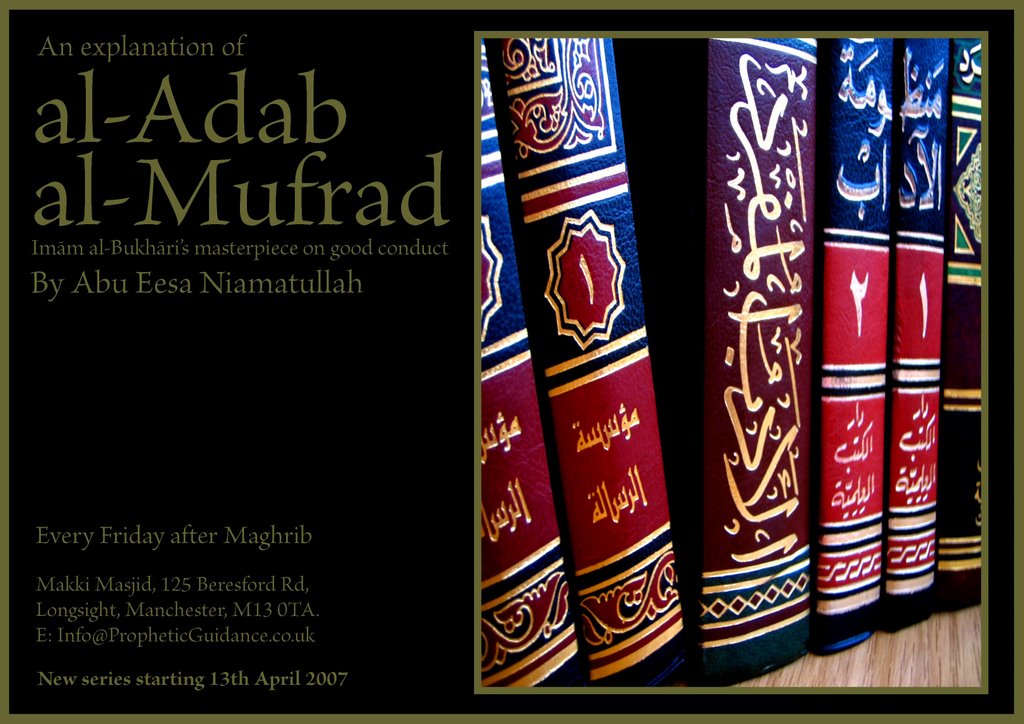
I can't wait.
I figured out a good use for this blog: I will type my notes here insha'Allah.
I hope the Prophetic Guidance team would put the lectures up on youtube; 10pm is a bad time to be able to watch anything in our house and I can't watch it on the Islam Channel website either. I really want to catch up on the classes I missed.
Wednesday, 4 April 2007
Me and My Mother
There's a lot of difference between my mother (may Allah preserve her) and I. Her resilience, patience, strength, independence, wisdom and self-assuredness strike me at times and make me feel like I inherited only some of her physical attributes and not the admirable qualities. These qualities would have definitely been indispensible in the last 2 years for me not to mention throughout life - which is inevitably full of injustice, hardship and tests.
But there are a lot of differences between my life and my mothers'. She can barely remember her parents as they passed away when she was very young. She was married off pretty much as soon as she reached puberty and thenceforth began a life of marital/in-law strife - typical life of marriage if you ask me, but hey I'm a (justified) cynic. She had to adapt to the settings God put her in and hence she either applied all the qualities she already had or acquired them - you can't really know which one but either way they became part of her character. Whereas me - I've had a life of ease. Of course, if this was 10 years ago I'd tell you I had the worst life imaginable but I was of a different species then - a teenager. My "hardships" amounted to my parents not letting me wear "trendy western clothes", not letting me go out with my friends, coming down on me like a ton of bricks if my brother spotted me in school within a 10 metre radius of a guy etc. I wasn't pressured to continue my education after college, I wasn't pressured to do housework, I wasn't pressured to even earn a living and after my family were fairly confident that I wasn't in any danger of becoming a tart :-D they let me wear what I wanted.
Sometimes I wonder what kind of person I would've been had my upbringing been different. Had I been accustomed to hardship, difficulties now would not be so trying. Of course, that's not really useful because I can't alter what has passed and I can't (and don't) regret the blessing of ease, walhamdulillah. What I can do is behave as though I have patience, fortitude, self-confidence, resilience. I can keep my mood swings under the wraps of smiles. I can don a fake coat of thick skin to sheild me from what others say and think of me. The outward actions will be pretty much the same as someone who already has these qualities naturally but inwardly it will be more of a struggle. Until insha'Allah they become second nature to me.
But there are a lot of differences between my life and my mothers'. She can barely remember her parents as they passed away when she was very young. She was married off pretty much as soon as she reached puberty and thenceforth began a life of marital/in-law strife - typical life of marriage if you ask me, but hey I'm a (justified) cynic. She had to adapt to the settings God put her in and hence she either applied all the qualities she already had or acquired them - you can't really know which one but either way they became part of her character. Whereas me - I've had a life of ease. Of course, if this was 10 years ago I'd tell you I had the worst life imaginable but I was of a different species then - a teenager. My "hardships" amounted to my parents not letting me wear "trendy western clothes", not letting me go out with my friends, coming down on me like a ton of bricks if my brother spotted me in school within a 10 metre radius of a guy etc. I wasn't pressured to continue my education after college, I wasn't pressured to do housework, I wasn't pressured to even earn a living and after my family were fairly confident that I wasn't in any danger of becoming a tart :-D they let me wear what I wanted.
Sometimes I wonder what kind of person I would've been had my upbringing been different. Had I been accustomed to hardship, difficulties now would not be so trying. Of course, that's not really useful because I can't alter what has passed and I can't (and don't) regret the blessing of ease, walhamdulillah. What I can do is behave as though I have patience, fortitude, self-confidence, resilience. I can keep my mood swings under the wraps of smiles. I can don a fake coat of thick skin to sheild me from what others say and think of me. The outward actions will be pretty much the same as someone who already has these qualities naturally but inwardly it will be more of a struggle. Until insha'Allah they become second nature to me.
Subscribe to:
Posts (Atom)